No Outside
The Limits of Mathematics and Logic From Any First-Person Perspective
Matthias Gruber · book · 2026
Every observer is a proper part of what it describes. That holds for a human, an animal, a machine, and a creature inside a structure laid out statically on a disk. The book asks what follows for mathematics and logic when nobody gets to stand outside.
From this and two related facts the familiar limits follow, each under the conditions it needs: incompleteness and undecidability, the uncomputable continuum, the impossibility of certifying randomness from inside an experiment, and the failure of first-person evidence to decide between hypotheses about one’s own origin. The second half of the book asks what still passes between perspectives. Refutations do, and so does relational structure, which makes mathematics the most shareable part of a world-model.
The argument covers its author. He looked for an exemption and did not find one.
- Part I — Mathematics as a Language of Models
- Part II — Logic Seen From Inside
- Part III — Physics From Inside
- Part IV — The Inside of a Structure
It builds on two earlier works: the Four-Model Theory of consciousness and a cellular-automaton cosmology.
Read the book
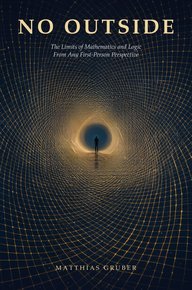 Book · open access · Zenodo
No Outside
The Limits of Mathematics and Logic From Any First-Person Perspective. 15 chapters, 8 figures, CC BY-NC-ND 4.0.
Companion paper
Preprint · Zenodo The Worm on the Disk Stored Trajectories and the Triviality Problem. Developed from Chapter 14 of the book: if a simulated organism has experience, a static record of its whole trajectory has the same experience.From the book
These passages were taken from a late draft; the published text on Zenodo is authoritative.
The rationals model the division of wholes. Half a loaf is a loaf divided into two parts, one of which is taken. The rules for adding fractions are the rules for bringing divisions to a common size before counting the parts. Again the fit is good wherever wholes can be divided evenly, and again it is a model: it assumes that division can go on as long as one likes, which is false for loaves and sheep and, as far as anyone knows, false for anything physical below some scale. As much as it may hurt the sheep, one can cut it in half, and quarter it, and sell small portions of it on a market, but at some point one ends up with mush, and the market value suddenly drops to zero.
Human perception is strongly tuned to symmetry: bilateral symmetry is a reliable cue that something is an animal, predator or prey, and the visual system detects it quickly and before attention is directed to it. A large part of mathematical physics consists of symmetry principles, and a cosmology such as mine is at bottom a symmetry claim, the same boundary structure at every scale. It would be a little embarrassing if mine turned out to rest on the reflex by which a rabbit notices a fox. Symmetry may be everywhere in the world. It may also be what minds tuned to symmetry find wherever they look. From inside, the two are indistinguishable, because the evidence for the first passes through the apparatus that would produce the second.
The visual illusions make the structure visible. In the Müller-Lyer figure, measuring the two lines and finding them equal does not make them look equal; the implicit model that reads line length from the arrowheads is not available for correction by a statement in the explicit one. It can be overruled in action, by trusting the ruler. It cannot be argued out of its output. I have measured the two lines more often than a grown man should, and they still look unequal.
The 2015 book, after setting the halting problem aside as irrelevant to how brains work, allows it one application (Gruber, 2015). Whether a mental model — even a consistent one — can be serialized is something we can begin to judge only when we try to serialize it. If the attempt succeeds, the answer is given. If it does not, we cannot decide whether serialization would have been possible in principle. In plain words: we cannot decide in advance whether we will be able to explain what we think. Anyone who has opened a sentence in a meeting with the word "basically" has run the experiment live.
What the simulation cannot contain is its own current generation, represented as the cause of what it is generating at that moment. This omission is different in kind from the many things any model leaves out. Most unrepresented causes are covered by stand-ins: hunger is referred to an empty stomach, with no representation of the physiology that produces the feeling, and the stand-in is good enough that nothing seems missing. Nobody has ever postponed lunch for want of a theory of hunger. The apparatus has no adequate stand-in, because a stand-in for the whole of what is generating this scene would have to be generated inside the scene by the very process it stands for, and would then be one more item in the scene, not the process.
A law that holds at our level is compressed data, valid within a scope and silent beyond it. Its validity within the scope travels: anyone at that level can test it and obtain the same result. Newton's law of gravitation lost its standing as a fundamental law a century ago and still computes the trajectories of spacecraft, and every observer who uses it inside its scope gets the same numbers. The spacecraft have not been told.