Matthias Gruber

Independent researcher in consciousness, intelligence, cosmology and computation. Author of the Four-Model Theory of consciousness.

Read the FMT paper The FMT wiki ↗

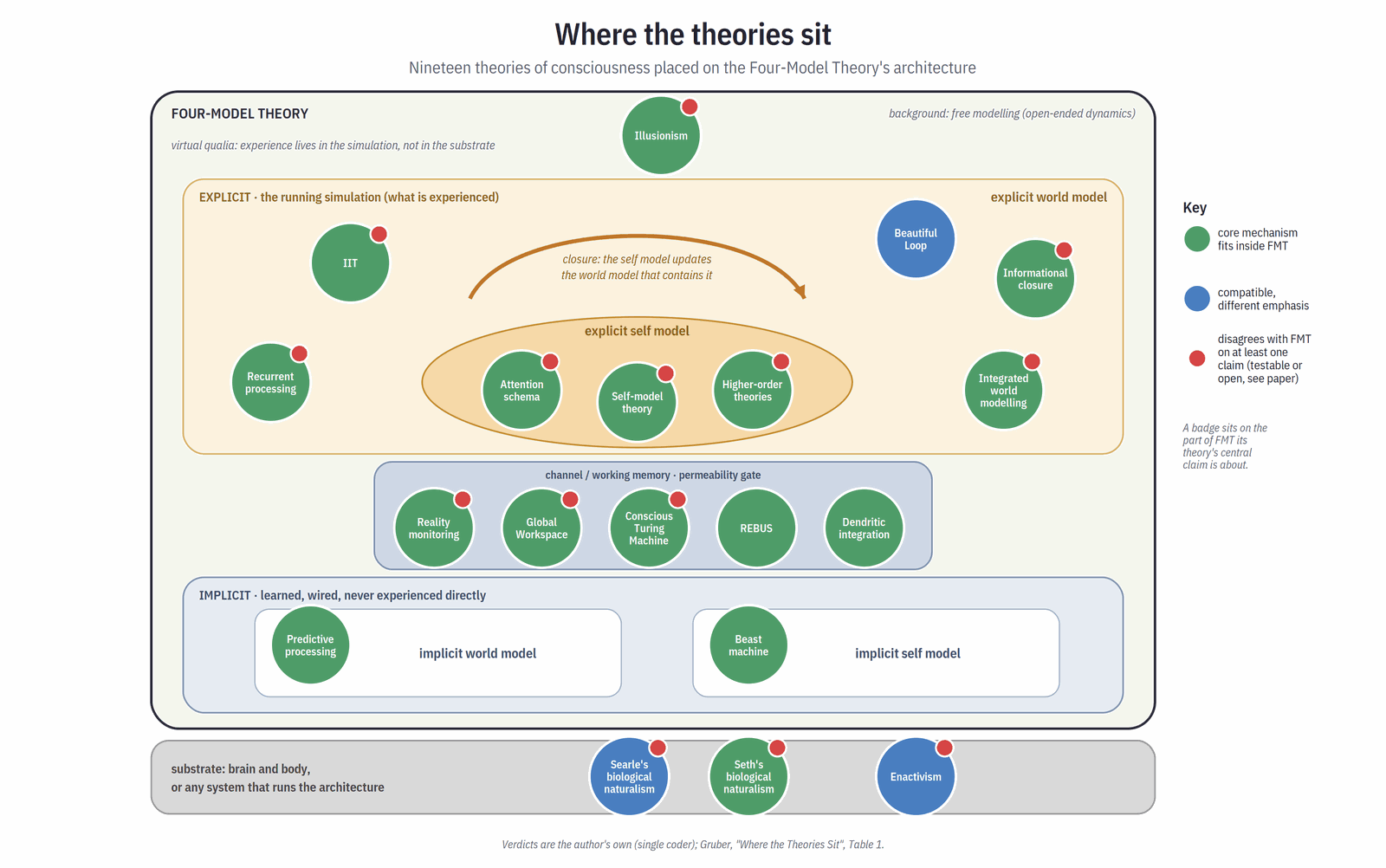
Where the theories sit: the Four-Model Theory's architecture (explicit world and self models, channel, implicit models, substrate) with nineteen theories of consciousness as badges on the component their central claim is about; green = core mechanism fits inside FMT, blue = compatible, red dot = disagrees on at least one claim
Where the theories sit: nineteen theories of consciousness placed on the Four-Model Theory’s architecture. Verdicts per claim and the experiments that would decide each disagreement: Gruber 2026, doi:10.5281/zenodo.23496102. Full-size image

Survey: Perception and beliefs about the mind — about 25 minutes, anonymous, open to everyone until 24 January 2027.

Take the survey

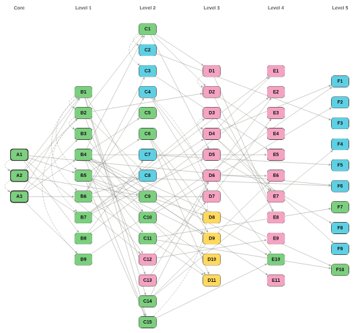
The FMT prediction map: claims in six columns joined by arrows Interactive FMT Prediction Map The theory as a network of claims and predictions. Compare it side by side with GNWT, IIT, PRM and RPT. Open the map → Booklet drawing: a figure in an overflowing bathtub under a shower, labelled dreams / psychedelics For computer-science students Run a registered experiment Small, falsifiable tests of the theory in code. Register first, run the grid, return every row. How it works →
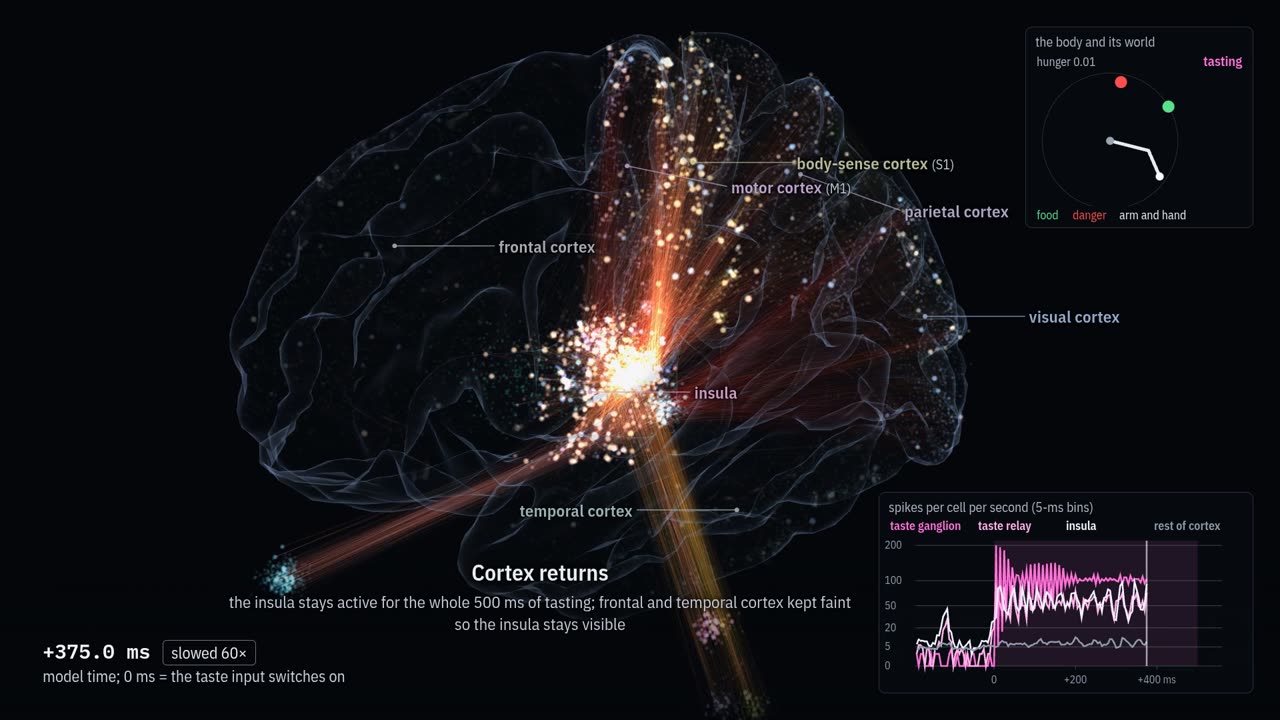
Frame from the video: a translucent brain with labelled areas, lit by spikes around the insula, next to small panels showing the arm with the food and the firing rates
A simulated creature tastes a meal. One spiking network of 12,292 model neurons controls an arm that forages for food. When the hand reaches the food, the taste nerve fires, and within 15 ms the activity climbs through the taste relay in the thalamus to the insula, then reaches the other relays and the body-sense cortex. Every flash is a spike from the simulation, slowed 60× and, around the meal, 600×. From crucible. The video plays from YouTube (privacy-enhanced mode) when you click it.

Research areas

Recent papers

Preprint

The Four-Model Theory of Consciousness

A Simulation-Based Framework Unifying the Hard Problem, Binding, and Altered States

Consciousness as ongoing self-simulation: four kinds of model, split by scope (world or self) and mode (implicit or explicit), on a substrate capable of open-ended computation.

2026 · Zenodo · doi.org/10.5281/zenodo.18669891 · Read (Zenodo)

Preprint

Emergent Spacetime from Self-Referential Computation

A Hierarchical Cellular Automaton Framework (SB-HC4A)

A cosmological model in which the universe is a self-referential holographic Class 4 automaton bounded at every scale by singularity surfaces.

2026 · Zenodo · doi.org/10.5281/zenodo.18698605 · Read (Zenodo)

Preprint

In-Silico Tests of the Four-Model Architecture

Self-Referential Closure, Self-Modelling and Criticality in Model Systems

The theory's functional commitments tested in model systems, with the results sorted by the kind of evidence they give.

2026 · Zenodo · doi.org/10.5281/zenodo.21610993 · Read (Zenodo)

All publications →

Books

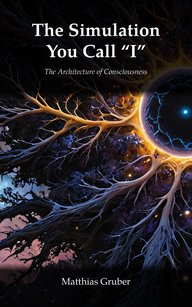
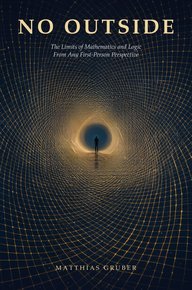
No Outside is open access on Zenodo: doi.org/10.5281/zenodo.23473517

Die Emergenz des Bewusstseins (2015, German), the original statement of the theory, is open access on Zenodo: doi.org/10.5281/zenodo.23538664

MoC7 2026 · Poster P56 archive: poster, paper, handout →