The theories here are architectural, so they can be built and run. This page collects the code that tests them, the earlier work on simulation and optimization, and the work on what any describer inside a system cannot know.
How the programme itself is run, with agent sessions that hand over in writing and check each other: Working with agents →
crucible
crucible tests the Four-Model Theory in code: small, falsifiable experiments on rate networks, spiking networks, simulated bodies and one small quadruped robot. Hypotheses and analyses are committed before the data exist, and null results count.
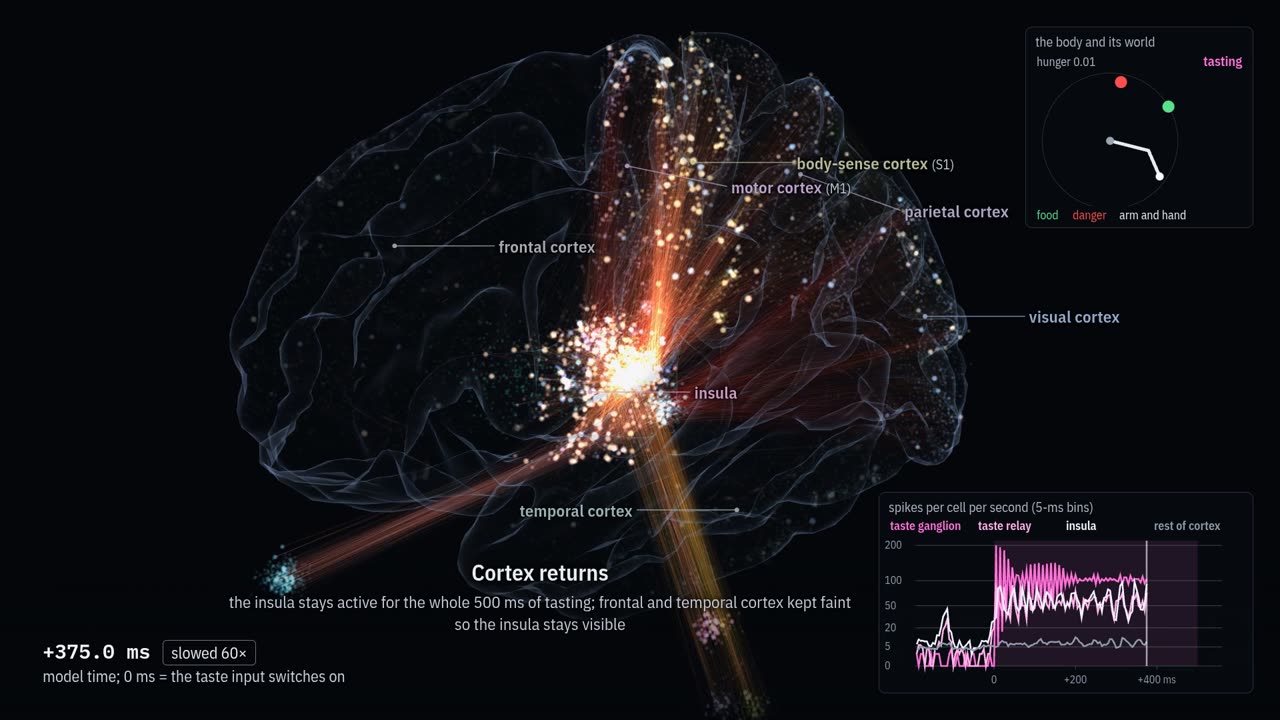
A simulated creature tastes a meal. One spiking network of 12,292 model neurons controls an arm that forages for food. When the hand reaches the food, the taste nerve fires, and within 15 ms the activity climbs through the taste relay in the thalamus to the insula, then reaches the other relays and the body-sense cortex. Every flash is a spike from the simulation, slowed 60× and, around the meal, 600×. From crucible. The video plays from YouTube (privacy-enhanced mode) when you click it.
The Limits of Mathematics and Logic From Any First-Person Perspective
Every observer is a proper part of what it describes. The book follows that fact through mathematics, logic and physics, and asks which limits it imposes on any describer, human or machine. 15 chapters, open access (CC BY-NC-ND 4.0).
If a simulated organism has experience, a static record of its whole trajectory has the same experience. Triviality is blocked by counting the decoding map as an object in the world. Developed from Chapter 14 of No Outside.
Conversion Cost and the Reversibility of Scientific Falsity Rulings
Which rulings that a claim is false are later reversed? The resistance of a falsity ruling to reversal scales with the cost of the conversion that established it, measured from records dated no later than the ruling. Develops Chapter 6 of No Outside.
Why the Limits of Embedded Description Travel as Refutations
A describer that is part of what it describes cannot hold its own current act as content, and cannot certify its description of the whole as complete. The paper states five such limits and argues that they hold as refutations: denying them contradicts what every claimant already presupposes.
 Book